Sunday, April 1, 2012

Packing a Political Punch: 2012 Elections and MEChA

From: http://www.yaledailynews.com/news/2012/mar/23/packing-political-punch/

Packing a Political Punch

Politics, the specialist way

Yale students may not be queuing around the block to sign up for positions on campaigns, but they are, it seems, going into 2012 with clear priorities about what they care about. If Yalies aren’t working to elect public officials, they certainly wish to inject their values into national policy debate.

One clear example of this were the 30+ comments in the News survey that mentioned women’s reproductive rights as the respondent's top political priority, and the recent flurry of Republican comments and legislation concerning similar legislation. Other individuals interviewed are determined to make their issues matter on the national stage this election year, even if they are not currently hot-button issues.

“My time on campus has introduced me to others who pursue their causes with a similar level of passion to my own — these elections mean a lot of different things to people, and I am constantly impressed with the level of commitment to issues that I see in other students here,” said Diana Enriquez ’13, who is involved with the campus Chicano advocacy group MEChA de Yale. “The stakes are high for many of us.”

Enriquez believes that the recently proposed DREAM Act, and state legislation such as Arizona’s SB 1070 helped reignite interest in the immigration debate. She added that she hopes to get her fellow students more interested in issues such as racial profiling, and the image of immigration even beyond the Latino community.

“I collect stories. I share stories about my family, the communities we've worked with in New Haven and people I worked with at home. We talk about students like us who face uncertain futures because their immigration status puts them or their families at risk of deportation,” Enriquez said. “The human interest story is always a powerful one, and my role as a student activist is to remind other students how real these issues are for the people around them.”

Getting discussions going, she added, is a vital first step. Recent issues surrounding the implementation of the Secure Communities program, which has been attacked for the precarious position in which it places illegal immigrants, will help stimulate continued interest, Enriquez said.

YDN backs MEChA's position on SCOMM

NEWS' VIEW: Secure Communities has met resistance in New Haven — and rightly so.

The Secure Communities program that took effect in Connecticut last week has met overwhelming resistance from citizens, scholars and city officials. The program — under which the FBI must share fingerprints of anyone arrested with Immigrations and Customs Enforcement for review, and ICE may in turn request that local prisons detain suspects — has prompted a number of concerns. Governor Dannel Malloy, Mayor John DeStefano Jr. and the Yale Law School’s Worker and Immigration Rights Advocacy Clinic have joined immigration activists in questioning the program on constitutional and practical grounds. They are right to be concerned.

New Haven has a turbulent history of federal immigration enforcement. A 2007 ICE raid in Fair Haven increased fear among the city’s Hispanic population. Citizens know that New Haven police do not often deport illegal immigrants. Enforcing Secure Communities may drive a wedge between citizens and police, threatening the community policing new NHPD Chief Dean Esserman has promised to return to the city.

Secure Communities is supposed to be used to deport dangerous criminals. Instead, as a September 2011 Department of Homeland Security report acknowledged, immigrants targeted by ICE through the program have thus far mostly been arrested for minor crimes, if any. Although most deported immigrants indeed live in the country illegally, Secure Communities may lead to undue detention. Moreover, deporting people who have committed no additional offenses is a misguided use of funds and resources.

Still more worrisome is that some police departments have checked fingerprints against an outdated list, leading to deportation of naturalized citizens. If the feds are going to tell the New Haven Police Department how to handle immigration enforcement, they ought to have a handle on how immigrants interact with New Haven officials. But in a telling gaffe, ICE recently sent an email about the program to former police chief Frank Limon, who hasn’t been in office — or in town — since October. A program so potentially damaging to police relations would be better handled by an agency more in touch with the city.

States have some power to control the program’s execution. New York, Illinois and Massachusetts have refused to enforce the federal mandate, which does not provide states with funds to enforce ICE detention. Connecticut could follow in their footsteps.

Malloy said he will handle enforcement of Secure Communities on a case-by-case basis. We applaud that decision. In some cases, the program may remove criminals from New Haven. In others, though, it may do little but undermine tenuous relationships between police officers and the communities they serve.

DeStefano has called Secure Communities “flawed and in need of correction” because it fails to target repeat offenders. Because the program is executed by the state, DeStefano can do little on his own to keep it out of New Haven. But if New Haven is forced into the program, at least DeStefano has shown he cares about his constituents.

The Law School clinic filed a class action lawsuit earlier this month to challenge Secure Communities’ constitutionality. We’re glad to see a murky program subject to scrutiny. Local lawyers’ engagement with the federal policy is a step towards reasserting local control.

Last week, New Haveners of all stripes banded together in objection to Secure Communities. At this point, perhaps that sort of clear — if cautious — united action is the best way to secure a community.

Panel opposes Secure Communities

Community activists convened in Sudler Hall Wednesday night to oppose Secure Communities, the federal government’s new program intended to deport criminals living in the country illegally.

The panel was jointly hosted by the Yale College Democrats, Movimiento Estudiantil Chicano de Aztlán (MEChA) de Yale and the University’s chapter of Amnesty International. Mayor John DeStefano Jr., Yale Law School professor Michael Wishnie, Armando Ghinaglia of Connecticut Students for a DREAM, Fair Haven Alderwoman Migdalia Castro and Latricia Kelly, the director of development and programs for Junta for Progressive Action, along with around 30 students, gathered to discuss their concerns about the program and future steps as it is executed nationwide.

While the program has been advertised as a narrowly targeted program focusing on violent offenders, its long-term implications may be broader, Wishnie said, describing the Secure Communities Act as the “latest effort by U.S. Immigration and Customs [Enforcement] to arrest and deport lots of people.” Under Secure Communities, criminal suspects’ information is run through ICE’s database following incidents as small as a routine traffic stop. If ICE’s information identifies the suspect as likely to be undocumented, the agency can issue a request to a state that it hold the suspect for up to 48 hours. Panelists expressed concerns that these detainment requests were issued too broadly. Less than a third of the people detained are actually dangerous criminals, Wishnie said.

“Your main goal is to target individuals with violent records, but you’re opening a Pandora’s box of ills to come into this state,” said Castro, whose neighborhood contains the city’s highest proportion of Latino immigrants.

Panelists also stressed that the program leads to insecurity in immigrant neighborhoods. In communities such as East Haven, which has a large Ecuadorian population, Kelly said, “there is a great sense of fear — people don’t want to go out, and don’t want to report crimes.” Lack of public understanding has created rumors that police are pulling people to check immigration papers, she said, adding that this has contributed to “the fear of being profiled … because you are a Latino or a person of color.”

Castro agreed with this assessment, and suggested that a public awareness campaign might be helpful in explaining the program to city residents.

DeStefano also highlighted New Haven’s track record of immigrant-friendly policies, which he said are under threat by the ICE program. The New Haven Police Department, DeStefano said, is not concerned with residents’ immigration statuses unless they have committed a crime, a result of an executive order he issued in 2006. He added that effective policing depends upon trust between a city’s residents and its police department. Without trust, he said, residents refrain from reporting crimes and are less cooperative with law enforcement officials.

Though he was critical of Secure Communities, Wishnie reminded attendees that ICE’s requests for detainment are not legally binding mandates. While a warrant undergoes a constitutionally mandated review from a judge, detainment requests are issued by ICE agents, and therefore it is up to states to comply with them or not, Wishnie said.

Gov. Dannel Malloy’s office clarified its stance toward Secure Communities on Tuesday, releasing a new policy which would result in the state’s compliance with most, but not all, detainment requests. Such a policy is promising, Wishnie said, because it demonstrates Malloy’s understanding that detainers are not binding. Wishnie said he believes Malloy is the first governor who has publicly decided not to honor all detainment requests.

Panelists called for students in attendance to get involved with community-based organizations, sign petitions and speak with representatives to oppose the program.

“The Secure Communities would turn the police into de facto agents of deportation, which would erode faith in police, and this is very risky,” said Sohara Shachi ’12, who attended the event. “That is a huge argument against it, especially in New Haven, where crime rates are high.”

Secure Communities is scheduled to be implemented nationwide by 2013.

http://www.yaledailynews.com/news/2012/mar/29/panel-opposes-secure-communities/

Friday, March 2, 2012

I Am a Yale Latino. Get Over It. (I have).

A little background to begin: My father is of Mexican descent. My mother is, like most white Americans, a mix of Irish and German heritages. As a testament to the feeble foundations on which things like race and ethnicity stand, I have been asked, at various times in my life, if I am Jewish, Peruvian, Greek, and Argentinean. I respond to those questions with a smile, and a correction that usually goes something like, "No, actually my dad's Mexican and my mom's white." But that says very little about me. It begins to say who my parents are, inasmuch as two adjectives can describe entire human beings. But what about Ryan Albert Mendías? I'll give a more complete answer here: I'm Latino (or Chicano, or Hispanic, or Mexican-American). I'm white (or caucasian). And--here's where the confusion kicks in--I consider myself a person of color. That last qualification definitely gives some people pause. How can you be both white and of color? We'll set aside the fact that interraciality is actually a thing, and we'll ignore that asking such a question drives an unnecessary wedge between two important parts of myself (you know, parts like my mother and father...). What I'll do is say a little bit about what those two markers of identity, Latino and white, mean to me.

Like most people of mixed heritage, my life has been one long lesson in multiculturalism. Moving in and out of different worlds, families, languages, and religions, difference is nothing new. Add to the mix that my parents have been divorced and that moving between those worlds involved, literally, relocating to a new physical and cultural space, and it becomes very clear that I was constantly aware of the disparate threads of identity that came together in me. The extent to which I've embraced either thread has shifted throughout my twenty years of life. Jealous of friends whose families came from Asia or Africa, I threw myself into my Irish heritage. Ireland--Europe, really--seemed so foreign, so far away, so, for lack of a better word, historical. I had read about the Irish Famine, I had learned about Ellis Island; forcing my grandfather to tell me everything he knew about his grandparents' voyage to the 'New World' was a way of making myself part of something larger than myself. Mexico, in comparison, seemed so close, so banal, so pedestrian. So many of my elementary school friends and classmates had parents who'd come across the border at some point in the recent past or were themselves born in Mexico. Spending significant portions of my childhood in predominantly Latino neighborhoods, surrounded (whenever I was with my father) by Latino people, that part of myself seemed familiar to a fault. Of course, my tumultuous relationship with my dad and step-family coupled with an embarrassment about their (I suppose, our) poverty meant that my Latino heritage was something unforeign, unexciting, and unwanted.

But over time, things changed. Spending more and more time with my white, upper middle class friends made me realize just how important being a Chicano really was. I had long since abandoned my shame about falling into the category of 'poor Mexican family' every time I went out with my dad and step-sisters (who were browner than me). Whenever those friends spoke about the 'ghetto parts' of the city (often, places where I had lived), I both bristled with annoyance and swelled with pride--even if I didn't 'look Latino,' I had access to knowledge which they were so completely unaware of. In almost a complete turnaround, I started to feel deeply uncomfortable with the color of my skin; I felt like a fraud in so many ways: whenever someone assumed I was white and, paradoxically, whenever I told someone I was Latino. I couldn't win, as far as I was concerned. In grappling with this identity and dealing with the privilege that 'looking white' conferred upon me, any discussion of race or ethnicity struck me with a profound discomfort. That discomfort flared in my senior year of high school; every time I checked "Latino"--even when I checked "white" (which I always did)--on a college application, I felt like I was lying. Months later, the joy and relief of my college acceptance letters were always tempered by a deep sense of guilt.

But, ironically, it wasn't until I actually got to college that that guilt began to subside. It wasn't until I joined a community of Chicanos, Latinos, and other people of color who came in all shades that I really knew what my identity meant. I learned that being simultaneously white and brown was an integral part of my existence, that the contradictions embedded within that identity present their own sets of challenges and privileges, that upholding both halves of my heritage doesn't make me a fraud, it doesn’t make me anything other than myself: a person with all the knowledge and experiences that a life spread out across two cultures has to offer.

Ryan Mendías, BR'13

Wednesday, February 29, 2012

ECCSF @ Brown!


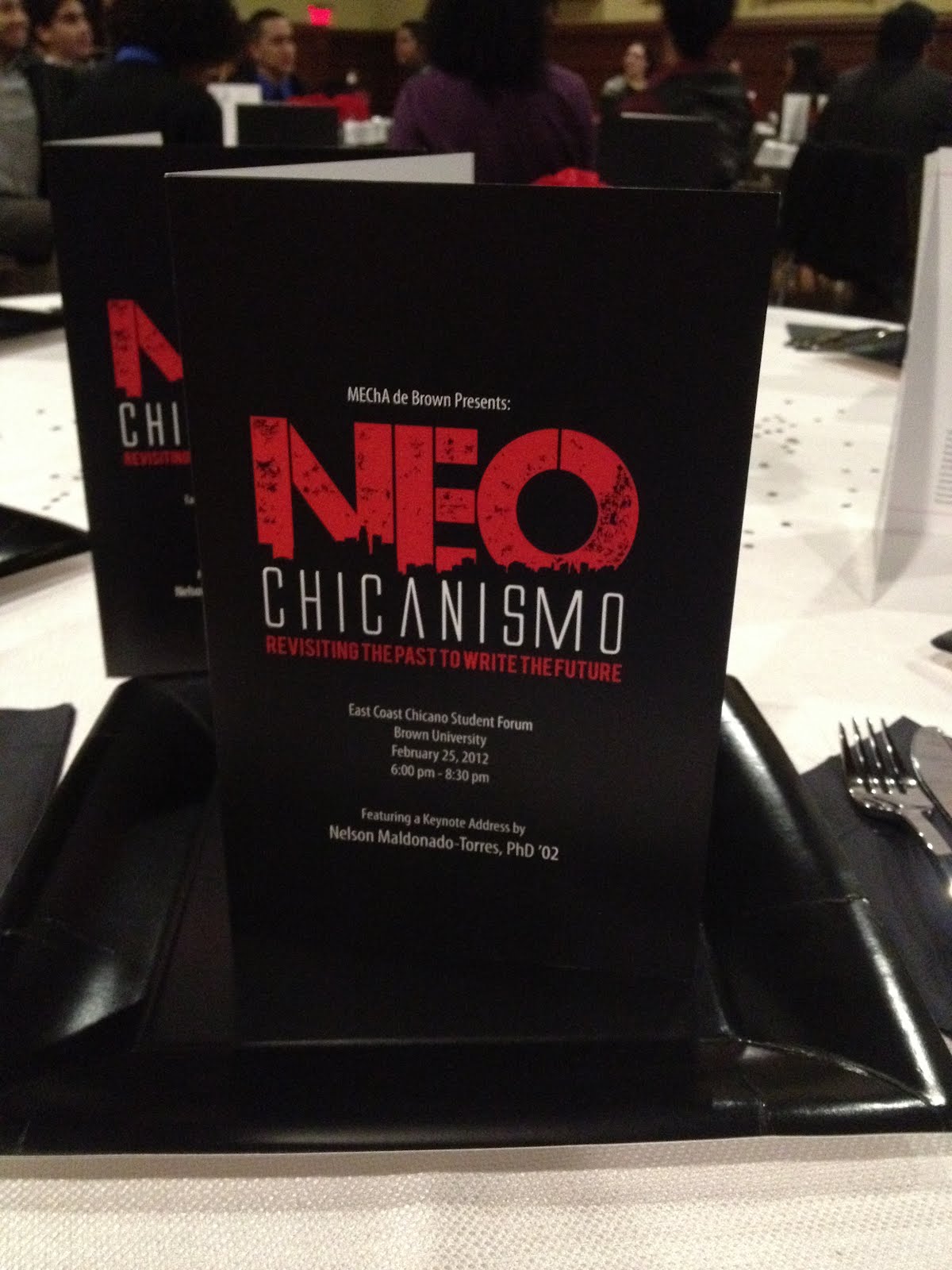
This past weekend, four MEChistas joined dozens of other students from throughout the East Coast at MEChA de Brown's conference on Neo-Chicanismo. In addition to meeting and socializing with other Chicanos, MEChA de Yale's representatives listened to presentations on topics such as the History of the Chicano Movement, the Literature of the Chicano Movement, and the future of the Chicano Movement. MEChA de Yale was able to connect with its fellow MEChistas and Chicanos on the East Coast and learn more about each others' efforts to redefine and expand the Chicano Movement. MEChA de Yale looks forward to the next conference at Cornell in the Spring and appreciates the great hospitality shown by Brown University MEChistas!

Con mucho MEChA amor,
-Juan Díaz

Sunday, February 26, 2012

For a Good Discomfort

For most of my life, I grew up in South Central Los Angeles. Mostly African Americans and Hispanics/Latinos, many who have recently immigrated, live in my neighborhood. South Central Los Angeles is also notorious for its poverty, failed school system, and gang violence to the extent that the city decided to change the name of the area to South Los Angeles. This summer I left the comfort of of bodegas, Spanglish, and Mexican and Central American food to come to Yale, a dream come true.

Although I love Yale, the transition to Yale has been everything but easy. I miss eating pupusas and tacos with my family, speaking Spanglish, listening to my grandfather discuss Latin American politics and Hugo Chavez, listening to the chisme of the neighborhood, and not having to dress in layers. I have also had to come to terms with my identity. This year, I have come to terms with what it means to be a Latina woman from a disadvantaged neighborhood. Being away from home has made me more attune that my reality is alien to others.

Out of ignorance, students have made very hurtful and bigoted comments which make me uncomfortable. My first memory of Yale is of being asked a hurtful question. A fellow Yale admit asked me “Are you actually Hispanic? Or did you just say that to get in?” after seeing my name tag that contained my surname: Cruz . I did not know what to say. Yes, I am actually Hispanic but also I felt hurt that my accomplishments were belittled because of my ethnicity. He later went on to criticize institutions like Yale for educating international students and immigrants. Uncomfortable with my own skin and uncomfortable with my current situation, I am often flabbergasted and speechless. Yet, my own silence disturbs me and makes me feel guilty. While studying for calculus or heading to class, my thoughts begin to consume my mind. I am ashamed of my silence; I am supposed to be a Yale student. Yale students are courageous, eloquent, and the “leaders of tomorrow”. Yet, my silence mocks me and I revert to feeling like an insecure middle school student. My shame and guilt are also combined with anger. Why should I have the obligation to speak up? Why can’t other students be cognizant of the backgrounds of other students?

Recently, this discomfort has become more perverse to the extent that I have turned to friends and mentors here at Yale. I have found solace within talking to other MEChistas but also with friends who do not share my story. A recent dinner with a friend has shifted my paradigm regarding my own discomfort. My friend told me, “Your discomfort is actually a really good thing. It means this institution is changing.” Decades ago, it would have been impossible for me to get a college education nevertheless a Yale education. Yale is changing; it is becoming more inclusive and diverse. It is easier to be a student of color here then it was a couple of years ago.

For this reason, Yale I encourage you to share my own feeling of discomfort. Let us have an open discussion on issues of race, class, gender, sexuality, citizenship and identity that can be at times uncomfortable and awkward. I have broken my silence. I am eager to listen; Yale tell me your story because there isn’t such a thing as the average “Yalie”.

----

Roselyn Cruz

Saybrook College Class of 2015

Borderland Identity

Since coming to Yale, I have been more conscious about my identity. In my home town of South Central Los Angeles, there are so many Latinos that I never paid much attention to my identity. As a child of two immigrants, I live in the borderlands that Gloria Anzaldúa so beautifully describes.


I am neither Guatemalan nor American. My birth certificate says I am a US citizen. I am a citizen of a country that does not want me. I live in a country where individuals want to end birthright citizenship to prevent people like me from being citizens. I also live in a country where school officials do not want Latinos to learn about nuestra historia. I live in a country in which Spanish is considered the language of the ghetto and poverty by a man who wants to be my president. The United States has also executed an imperialist foreign policy in Guatemala which has greatly impoverished Guatemalans. I also have trouble claiming a country that thinks that people like me are disposable enough to infect Guatemalans with syphilis and other venereal diseases.. I am not Guatemalan either. Although visiting Guatemala fills my heart with joy, my Spanish is foreign, my behavior is too “American”, and I am treated as a tourist. I am also not proud of country in which few families control all of the wealth of the county and a country that does not respect the rights of indigenous people.


Race and Ethnicity are separate from citizenship but yet a large part of one’s own identity. My complexion also complicates how others perceive my ethnic identity. My fair skin and reddish hair have caused many awkward misunderstandings. People have said very racist comments about Hispanics/Latinos while I have been present because they did not believe I was Hispanic. Likewise, I have been called a gringa and been spoken poorly about in Spanish. Growing up, I wanted darker skin so I could be acknowledged as being Latina. I did not like being called a gringa. Now that I am older, I am comfortable with my own skin. The color of my skin does not make me any less or any more Latina. I am Latina because I have a connection and love to Guatemala and Latin America.


I continue to live in the borderland. The terrain on both sides can sometimes be unfriendly. Yet, I will no longer be uncomfortable with the questions of my identity. As Gloria Anzaldúa states ,"Caminante, no hay puentes, se hace puentes al andar" (Voyager, there are no bridges. They are built as you walk). I am forging these bridges that deconstruct identity and citizenship.

--

Roselyn Cruz

Saybrook College Class of 2015